Loopio
From RFP chaos to proposal clarity
Designing a Proposal Intelligence System that keeps teams oriented and inside Loopio.
- Product Design
- UX Research
- Product Strategy
- Gen AI
- Enterprise SaaS
- Design Validation
- Role
- Product Designer & Researcher
- Industry
- B2B SaaS
- Platform
- Desktop Application
- Timeline
- Aug 2025 to Jan 2026
- Users
- Response & Bid Managers, SMEs
The problem
A 500-question proposal just landed. The bid is due in three weeks - and the team has no idea where to start.
Context
Loopio is an enterprise RFP automation platform used by proposal and bid teams to manage, respond to, and win complex proposals.
On day one of every new bid, a dense RFP arrives. Before anyone can answer a question, the team needs to understand priorities, hidden requirements, and deadlines.
The workaround reality:
- ChatGPT for high-level summaries
- Compliance matrices in personal Excel sheets
- Sales call notes that never reached the proposal team
- Multiple kick-off meetings just to get aligned
Why this mattered now
- Competitors and AI-first startups were closing the orientation gap. Customers were leaving Loopio to fill it.
- Churn-risk accounts said it plainly: Loopio helped them respond, but left them stranded at the start.
- Leadership formed a Strategic Insights team to build Response Intelligence - a reason to open Loopio before answering began.
My Contribution
Discovery & Research
Led CX-Sales workshops and 12 customer interviews to define the problem space for a new AI initiative.
Product Definition
Shaped the roadmap with PM from early concepts through PRD collaboration and sprint planning.
Design & Validation
Owned end-to-end design from conceptualisation through validation, handoff, and testing.
Launch & Impact
Closed the loop with UMUX surveys, customer feedback sessions, and Amplitude usage dashboards.
Research
I combined internal stakeholder discovery, customer interviews and proposal lifecycle mapping to understand where teams lost context, missed requirements and left Loopio to complete their work.
01 / Internal discovery
What Sales and CS were seeing
I brought Sales and Customer Success together to uncover proposal teams' unmet needs, existing workarounds, and opportunities to bring more intelligence into Loopio.
What teams asked for
“Scrap win themes from the RFP - pull out the shall have, must have, critical asks”
What it revealed
Strategic intent was extracted manually. Teams needed a structured way to identify must-have requirements and win themes in source documents.
What teams asked for
“Disconnect between what response managers know vs. what the sales team discussed with the client - win themes only communicated verbally, never tracked”
What it revealed
Client context was fragmented. Important insights from Sales conversations were not consistently reaching proposal teams.
What teams asked for
“Requirement gap: sometimes they'll mention a pain point but the questions don't ask about it”
What it revealed
Requirements went beyond Q&A. Pain points and requirements could be missed when they weren't phrased as explicit questions.
What teams asked for
“An high-level project summary or kickoff presentation would help keep the team aligned”
What it revealed
Teams lacked a shared starting point. A project summary or kickoff presentation could help everyone align before response work began.
Step 1 of 3 · Internal discovery
I explored a range of concepts across the proposal lifecycle, from bid qualification to pre-export checks.
01 · Go/No-Go
Should we even bid on this?
Teams had no structured way to make this decision inside Loopio - it lived in CRMs, spreadsheets, and gut feel. Context capture resonated in validation, but licensing and CRM migration anxiety blocked shipping this as a standalone first feature.
Go/No-Go concept prototype
02 · Proposal Summary & Checklist
Orient the team before a single answer is written
When a new proposal lands, Response Managers read hundreds of pages and run multiple kickoffs just to get oriented. Customers were ready to adopt Summary and Checklist immediately - themes, readiness, and a tracked requirements list replacing personal spreadsheets.
Proposal Summary and Checklist concept prototype
03 · Smart Review
Consistency and compliance at answer level
Teams used ChatGPT and Grammarly to rewrite SME answers. Tone and compliance flagging resonated, but tone variance by RFP type and GenAI restrictions for government bids limited near-term scope.
Smart Review concept prototype
Designing within the real world
Not every constraint makes it into a case study, the following three shaped the final design most.
AI Generation Cost
Decision: Manual, user-initiated generation kept value clear while giving the business control over usage.
Trade-off: Teams take one extra step to generate, but avoid surprise cost spikes from auto-runs.
Flow & infrastructure ownership
Decision: Found the nearest viable touchpoint in my team's scope instead of blocking on another team's project-creation flow.
Trade-off: Ideal entry point stayed out of reach for V1; orientation still landed where teams already work.
Checklist Categorisation
Decision: Shipped a leaner checklist with three basic categories; deeper categorisation moved later.
Trade-off: Less taxonomy at launch, faster path to a shared requirements list teams would actually use.
Shipped, Iterated, Improved
Two releases, shaped by beta feedback loops.
July – October 2025
Proposal Orientation
- Generated from source documents only
- PDF and Word file support
- Automatic RFP metadata extraction
- Citations linking every insight to its source
- Read-only checklist status visibility
- Top 5 win themes and 10 key asks
November 2025 – February 2026
Customize and control
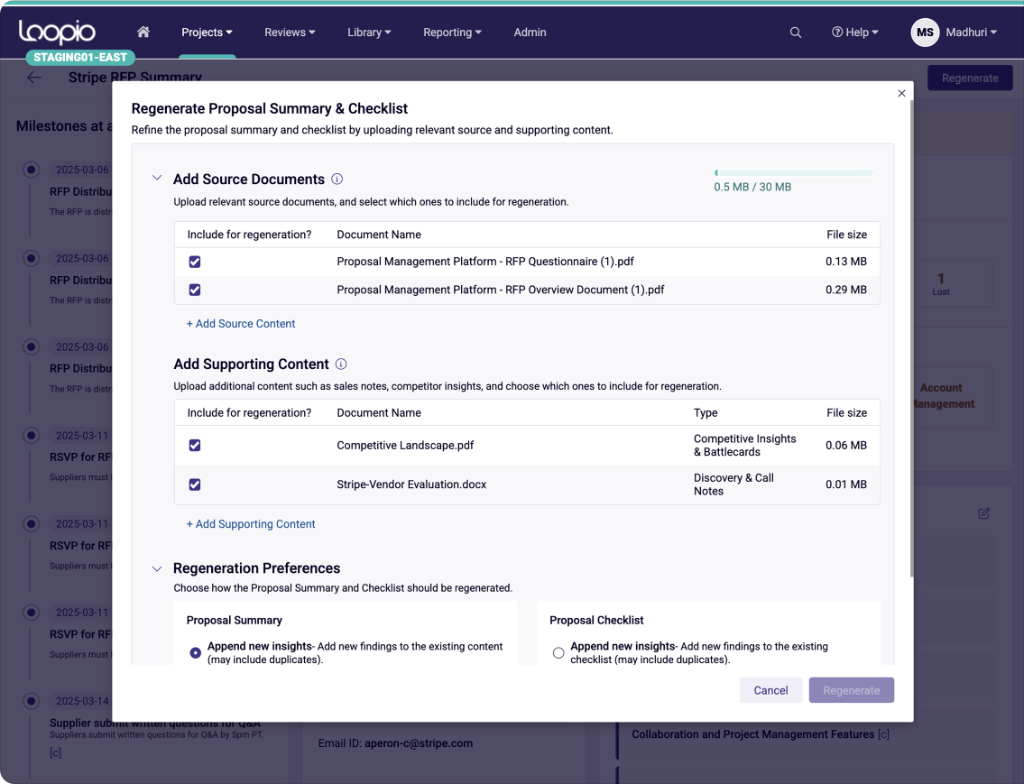
- Multi-document generation
- PDF, Word and Excel support
- Choose specific documents to regenerate from
- Append new generation or replace existing content
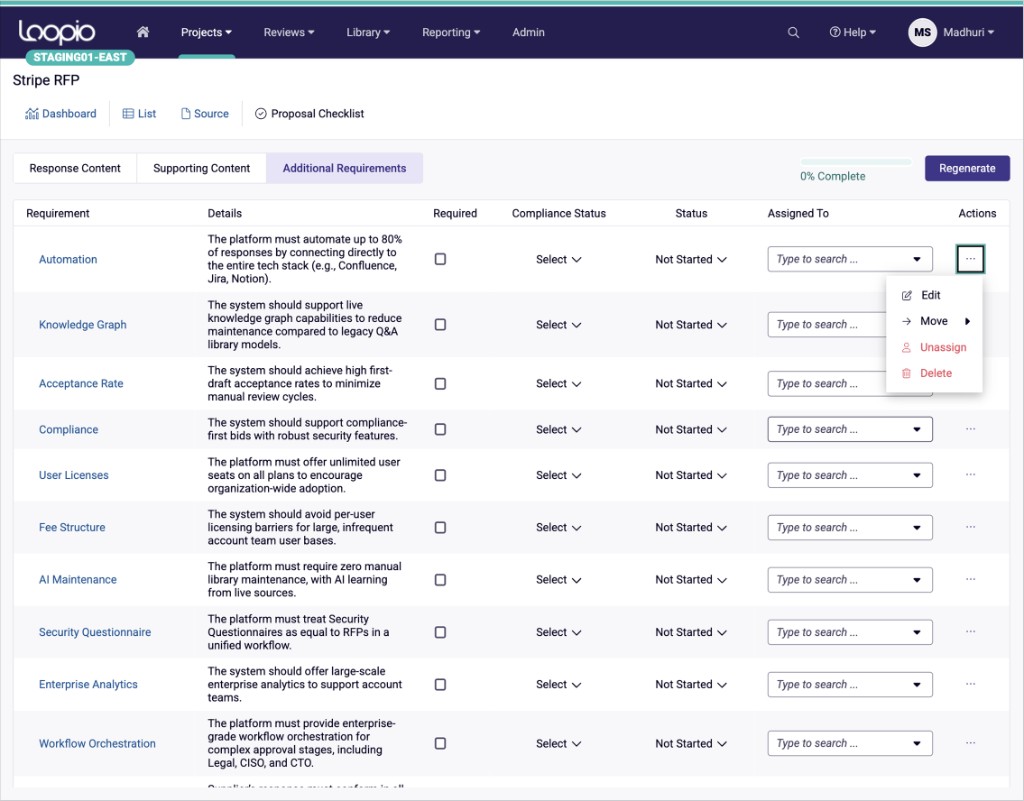
- Add, edit and delete checklist requirements
- Update task and assignment statuses
Impact
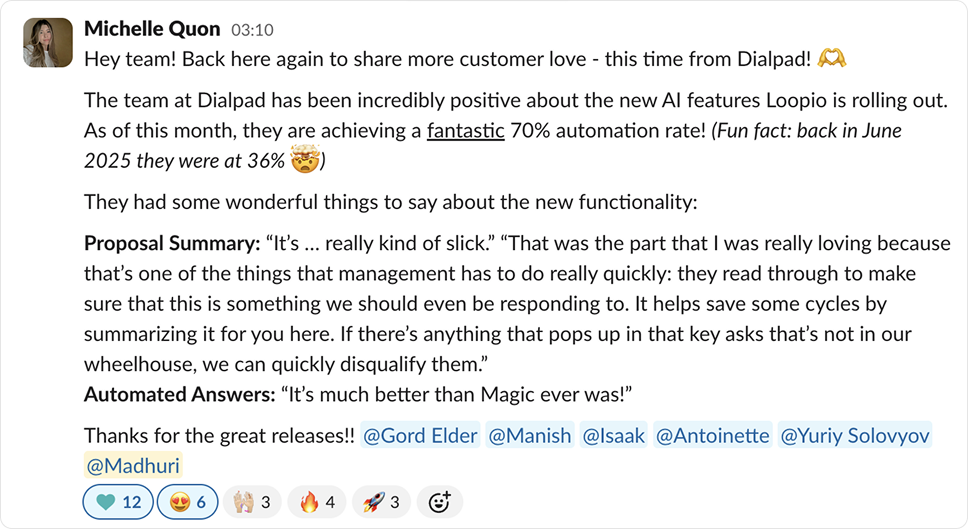
Measured usage movement at Dialpad, alongside qualitative signal from demos and beta customers. Outcomes reflect the broader product and go-to-market effort - not a single designer in isolation.
70%
Automation rate at Dialpad after Proposal Summary - up from 36% in June 2025.
36% → 70%
Same account, same workflow - Summary helped teams disqualify out-of-wheelhouse asks earlier.
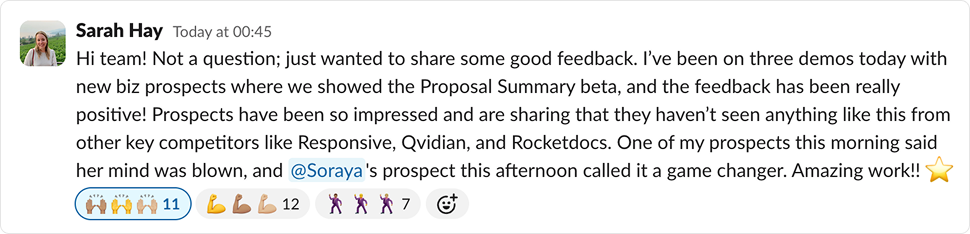
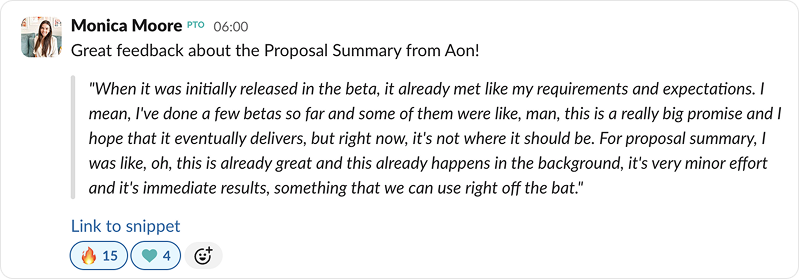
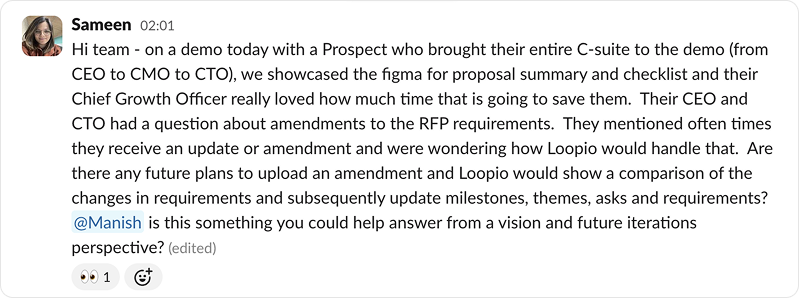
When It Landed
Feedback from sales demos, beta customers, and internal teams.
Final Designs, Live in Production
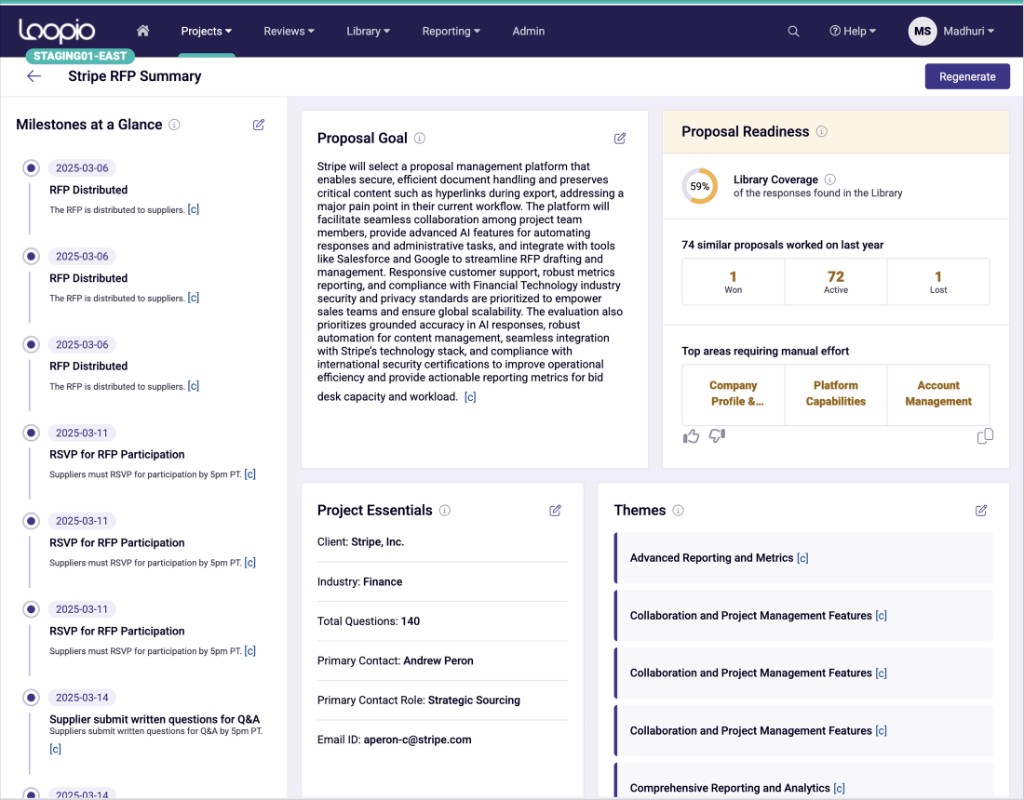
A shared starting point for every bid
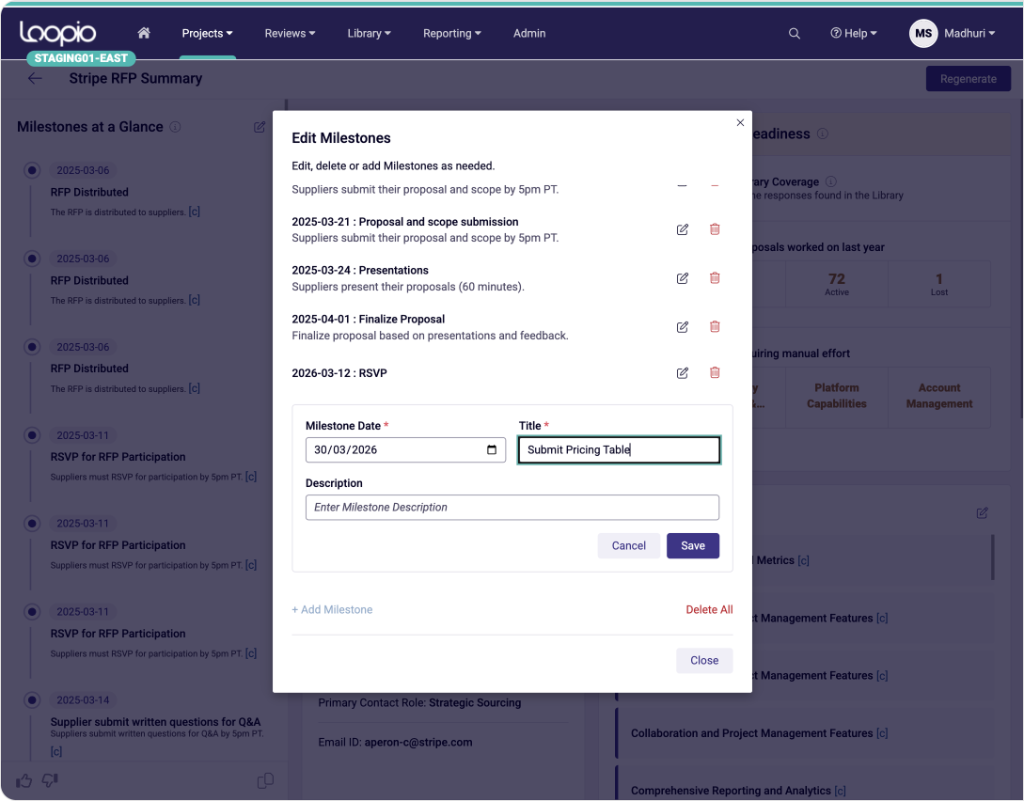
Give teams a faster way to understand a complex RFP. Bring the proposal goal, key themes, requirements, deliverables and milestones together in one place.
01 / 05
Reflections
What I learned
Understand the problem thoroughly
Customer conversations and Gong calls revealed a broader opportunity than replicating a competitor's feature. They reframed what we were actually solving for.
Design within real-world AI constraints
Enterprise privacy requirements shaped the generation architecture as much as the interface. The solution had to work within real data and workflow limitations.
What I'd do differently
Align on cross-team dependencies earlier
Project-creation ownership surfaced mid-process. Earlier alignment with the teams responsible for the workflow could have unlocked the right intervention point sooner.
Define AI quality criteria upfront
I'd align with data science on output accuracy thresholds during conceptualisation, rather than waiting until the final design stage.